Showing posts with label Tushita. Show all posts

Saturday, August 8, 2020

Study His Holiness the Dalai Lama's Teachings on Lama Tsongkhapa's Text In Praise of Dependent Origination

His Holiness the Dalai Lama, www.indialink.com.au.

His Holiness the Dalai Lama gave a three-day online teaching on Lama Tsongkhapa's text In Praise of Dependent Origination at the request of Tibetan Youth from August 4-6, 2020.

Two Dharma centers, Tibetan Buddhist Centre in Singapore, and Tushita Meditation Centre in India, independently organized online review sessions following each day's teaching.

Geshe Lobsang Yonten, www.savezanskar.org.

These review sessions were led by Tibetan Buddhist Centre resident teacher Geshe Lobsang Yonten and Tushita Meditation Centre visiting teacher Venerable Tenzin Legtsok.

Venerable Tenzin Legtsok and Pema, www.tushita.info.

The recordings of all of these teachings and review sessions, an official summary of each day's teaching, and Lama Tsongkhapa's text In Praise of Dependent Origination are freely available online for anyone to study.

Read the text In Praise of Dependent Origination

Tushita Meditation Centre described the text In Praise of Dependent Origination on www.tushita.info, "Je Tsongkhapa (1357-1419), the author of The Great Treatise on the Stages of the Path to Enlightenment and the teacher of the First Dalai Lama, is renowned as one of the greatest scholar-saints that Tibet has ever produced. 

"He composed his poetic In Praise of Dependent Origination the very morning that he abandoned all doubts about – the final view and attained a clear realization of emptiness, the essence of wisdom. Deeply moved by this experience, his gratitude to Shakyamuni Buddha increased exponentially inspiring him to compose a praise to Buddha for having taught dependent origination, the main reasoning which establishes that all phenomena are empty of inherent existence."

Download the text for free from www.dalailama.com in English, Tibetan, Chinese, Russian, Vietnamese, Japanese, German, Spanish, Korean, Hindi, Mongolian, Portuguese, French, or Italian.

Lama Tsongkhapa, CKSL event listing on www.evensi.com.

Read the Official Summary of Each Day's Teaching

Read "‘In Praise of Dependent Arising’ for Young Tibetans — First Day" on www.dalailama.com.

Read "‘In Praise of Dependent Arising’ for Young Tibetans — Second Day" on www.dalailama.com.

Read "‘In Praise of Dependent Arising’ for Young Tibetans — Third Day" on www.dalailama.com.

Watch the Teachings and Review Sessions

Day 1 - August 4, 2020

Watch the recording of "In Praise of Dependent Origination - Day 1" on the Dalai Lama Archive YouTube channel.


Watch the recording of "04.08.2020 Post Teaching Revision - Je Tsongkapa's In Praise of Dependent Origination" on the Tibetan BuddhistCentre YouTube channel.


Watch the recording of "Review Session Day1" on the Tushita Meditation Centre Dharamkot YouTube channel.


Day 2 - August 5, 2020

Watch the recording of "In Praise of Dependent Origination - Day 2" on the Dalai Lama Archive YouTube channel.


Watch the recording of "05.08.2020 Post Teaching Revision - Je Tsongkapa's In Praise of Dependent Origination" on the Tibetan BuddhistCentre YouTube channel.


Watch the recording of "Review Session Day 2" on the Tushita Meditation Centre Dharamkot YouTube channel.


Day 3 - August 6, 2020

Watch the recording of "In Praise of Dependent Origination - Day 3" on the Dalai Lama Archive YouTube channel.


Watch the recording of "06.08.2020 Post Teaching Revision - Je Tsongkapa's In Praise of Dependent Origination" on the Tibetan BuddhistCentre YouTube channel.


Watch the recording of "Review Session Day 3" on the Tushita Meditation Centre Dharamkot YouTube channel.

Tuesday, August 4, 2020

Pick from Twelve Upcoming Online Programs Offered by Tushita Meditation Centre in Dharamsala

Tushita Meditation Centre, Tushita Meditation Centre Facebook.

Tushita Meditation Centre, a retreat center in Dharamsala, Himachal Pradesh, India, has been offering online course after online course since the Covid-19 pandemic began.

Many of the courses have been offered for free, with the option to make a donation to Tushita to help keep the center operating while a big source of income - residential retreats - are on hold.

My first visit to Tushita was in early 2014. I joined the first residential retreat of the season, the 10-day Introduction to Buddhism course taught by Venerable Tenzin Legtsok. It was an impactful retreat and I've climbed the mountainside up to Tushita many times since then. 

I've stayed connected with Tushita during the Covid-19 pandemic by participating in their online course The Buddhist Path of Training the Mind taught by American nun Venerable Tenzin Drolma. I enjoyed it a lot.

They have recently added twelve more online courses to their calendar, and circulated the details in an e-newsletter.

Tushita 2020 courses, www.tushita.info.

Tushita's Upcoming Online Courses

"A Big Thank You!

"The support, love & encouragement we have received from all over the world during these challenging times has been absolutely mind blowing and indeed heart warming!

"Thanks to all your help & dedication to the Dharma, Tushita is able to survive the ongoing lockdown and can continue providing free online courses, teachings and other events.

"Please check out our exciting program for the remainder of the year - we are confident that you will find something beneficial & inspiring.

"With warm greetings and gratitude from the monsoony hill!
The Tushita Team"

Upcoming Program
September 21 – October 14 (October 15 & 16 Sponsor Day): Insight into Emptiness (intermediate) led by Venerable Drolma
November 15 – 19 (November 20 Sponsor Day): Cultivating Mindfulness and Emotional Balance led by Glen Svensson
November 19: Lhabab Düchen
November 23 – December 3 (December 4 Sponsor Day): Healing & Transforming Emotions (intermediate) led by Venerable Drolma

Class Times

Students join these online courses from all over the world, which is one of the things I loved about the online classes I joined. Since it would be hard to find a class time that works for everyone, students who registered for a course will receive the recordings for that course in case they can't make it to the live classes. Classes are held on Zoom.

Cost

Many of these courses are being offered for free. The others are offered as fundraisers for Tushita and have different pricing levels to make them accessible to more people.

After you register for a free course you will receive a confirmation email with all of the course details including information on how to make an optional donation.

This is from the email I just received after registering for a course:

"Offerings: Tushita is an NGO which covers its costs primarily through the donations from holding residential courses (that we are currently unable to host). This online program is only possible because of the kindness and generosity of previous students and benefactors.

"We are in our 5th month of lockdown and still have many bills to keep the center going and offer these online programs during this difficult time. We would really benefit from anyone that is able to make an offering. Anything is helpful.

"If you’d like to practice generosity and create great merit, please do so by donating to Tushita on our secure website:

"https://fpmt.org/support/tushita/ Select “Online Course” from the drop-down bar. Please include the Course Name in the Comment Section.

"Or support us by sponsoring an item from our wish-list:

Amazon wish-list"

Experience Level

All but the September 21 - October 14 course are open to beginners and experienced students alike. The September 21 - October 14 course Insight into Emptiness with Venerable Drolma has some pre-requisites.

The Buddhist Path of Training the Mind, www.tushita.info.

Where to Start

If you're new to Tushita and/or new to Buddhism then I recommend registering for the free two-week course The Buddhist Path of Training the Mind that I joined this year.

The course will be offered twice more in 2020: August 17 - 28 and October 19 - 30. (Class does not meet on the weekends.)

The Tushita website says, "Our resident teacher, Ven. Drolma, along with our meditation leader, Felipe, will be leading daily sessions Monday through Friday live via Zoom (an online platform). You will be able to see one-another and even ask questions directly!

"We will be offering online teachings and meditations in a program similar in content to our Introduction to Buddhism courses: Four Noble Truths & Mind, Buddha Nature & Meditation, Impermanence & Reincarnation, 4 Immeasurables & Bodhicitta, Karma & Purification, Equanimity & Anger, Attachment & Exchanging Self/Others, Emptiness & Selflessness and Refuge & Joyous Effort."

A big bonus of this online course is that the teacher, Venerable Tenzin Drolma, assisted by meditation teacher Felipe, offer the same class twice live each day, giving students in different time zones the chance to join class live and ask questions. This is an amazingly kind gift given how much work and time must be involved in offering even a single class session.

The course also includes group discussion time, similar to the residential retreats offered at Tushita. Participants will be divided up into Zoom meeting rooms to discuss with each other as part of the course. There is also time for questions and answers with the teacher, and guided meditations led by Felipe.


Free Introduction to Buddhism Booklet

You could also get started by reading the free Introduction to Buddhism booklet that is given to residential retreat students. It's available for download on www.tushita.info in English and Hebrew. 

(Israelis are one of the most represented nationalities in Tushita residential retreats. I recommend reviewing Tushita's 2009 - 2019 student statistics report complete with bar graphs and pie charts to see who is climbing the mountainside to Tushita in Dharamsala.)

Saturday, July 25, 2020

Study Anger, Anxiety, Patience, and Gratitude on Sundays with Venerable Tenzin Legtsok

Venerable Tenzin Legtsok and Pema at Tushita Meditation Centre, 2020. Tushita Meditation Centre Facebook.

American Tibetan Buddhist monk Venerable Tenzin Legtsok is teaching online each Sunday from July 26 through Sunday, August 16, 2020.

Venerable Tenzin Legtsok was the teacher for the 10-Day Introduction to Buddhism course I joined at Tushita Meditation Centre in Dharamsala, Himachal Pradesh, India, in 2014. He explains things so well. 

Tushita Meditation Centre is offering a lot of online courses during the Covid-19 pandemic. Venerable Tenzin Legtsok taught a few of the past courses.

The Event

Ngarik Gatsal Ling is hosting 1.5 hour Sunday Online Teachings on Zoom given by Venerable Tenzin Legtsok. 

Each session will be based on verses from Bodhisattva Shantideva's text A Guide to the Bodhisattva's Way of Life. Each session will consist of a teaching followed by a Q&A session.


Schedule

July 26, 2020:

Anger: Understanding and identifying the afflictive emotion to reduce anger through the practice of implementing antidotes.

August 2, 2020:

Anxiety: Understanding and identifying the afflictive emotion to reduce anxiety through the practice of implementing antidotes.

August 9, 2020

Patience: Understanding types and benefits of patience, methods to generate patience and learning meditation on patience.

August 16, 2020

Gratitude: Understanding benefits of gratitude, methods to practice the positive state of mind and learning meditation on gratitude.

5:00 PM IST - 6:30 PM IST

(4:30 AM PT - 6:00 AM PT)

Join the Zoom Sessions

The Zoom meeting ID and password are included in the above graphic. The same information is also listed on the Ngarik Gatsal Ling - Joyous Garden for the Five Sciences Facebook page in the body of the Facebook post where it may be easier to read.

Venerable Tenzin Legtsok

"Venerable Tenzin Legtsok is in the seventeenth year of the Geshe Studies Program at Sera Jey Monastic University in South India where he studies classical Indian Buddhist treatises and their Tibetan commentaries in the tradition of ancient Nalanda University. 

"He has been ordained as a Buddhist monk since 2001. Born in Virginia, USA he obtained a Bachelor of Arts from Kenyon College in 1995. For the past ten years he has tried to make basic Buddhist teachings accessible to various audiences in India and the US through lectures, essays, and meditation instruction."

Source: Ngarik Gatsal Ling Centre

Watch recordings of many teachings given by Venerable Tenzin Legtsok on the Choe Khor Sum Ling YouTube channel.

Thursday, July 23, 2020

Create Merit While Celebrating Choekhor Duchen

Choekhor Duchen, Twitter.

Friday, July 24, 2020, is Chokhor Duchen, the day people around the world will commemorate the anniversary of Shakyamuni Buddha's first teaching.

Chokhor Duchen is a merit multiplying day. The merit received for any positive actions done on July 24 will be multiplied. This week, I have been sharing some opportunities to create merit:

Help Pay Dharamsala Animal Rescue Staff Salaries on Chokhor Duchen

Help Supply Volunteers with Dog Food for Street Dogs in Nepal on Chokhor Duchen

Make Offerings to Tibetan Buddhist Nuns on Chokhor Duchen

There are many programs scheduled for Chokhor Duchen. Participation in these programs is another opportunity to create merit. Here are just a few of the programs taking place on Friday, July 24.

Tibet House New Delhi

Geshe Dorji Damdul will lead the taking of the Aspirational Bodhisattva Pledge and will give a teaching on Four Noble Truths with Emphasis on the Truth of Cessation of Suffering.

Choekhor Duchen, Tibet House New Delhi e-newsletter.


The Event

The Tibet House New Delhi poster says, "Celebrating Choekhor Duechen (The First Turning of the Wheel of Dharma) led by Ven. Geshe Dorji Damdul, Director, Tibet House, New Delhi.

"All are welcome.

"10:30 AM - 12:00 PM IST: Aspirational Bodhisattva Pledge
2:00 PM - 3:30 PM IST: Four Noble Truths with Emphasis on the Truth of Cessation of Suffering"

Schedule

July 24, 2020

10:30 AM - 12:00 PM IST
2:00 PM - 3:30 PM IST

(July 23 from 10:00 PM - 11:30 PM PT and on July 24 from 1:30 AM - 3:00 AM PT)

Watch the Livestream

To watch Live - Tibet House Facebook

Geshema Tenzin Deden, Gompa Services Facebook.

Jamyang Choling Institute

A pre-recorded teaching from Geshema Tenzin Deden, given in English and recorded at Jamyang Choling Nunnery and Institute in Himachal Pradesh, India, will be made available for viewing on the Gompa Services website.

The Event

The Gompa Services website says, "On the auspicious occasion of Chokhor Duchen (the anniversary of Shakyamuni Buddha’s first teaching on the Four Noble Truths), we are pleased to announce a free webcast on July 24th, 2020 of a teaching titled ‘The Significance of Chokhor Duchen and the Four Noble Truths’ by Geshema Tenzin Deden at Jamyang Choling Nunnery and Institute, Dharamsala, India. The teaching is given in English.

"Geshema Tenzin Deden is a teacher and senior nun at Jamyang Choling Nunnery and Institute. Originally from Kanam, Kinnaur, she received her monastic ordination from His Holiness the Dalai Lama at the age of twenty in Bodhgaya. Since 1989, she has been engaging in the rigorous study of Buddhist philosophy, Tibetan language, and other courses at the Jamyang Choling Institute. After completing seventeen years of study of the five major texts, she participated in the Geshema degree program, which was formed under the kind guidance of His Holiness the Dalai Lama. In 2016, she completed her study of Buddhist Philosophy and was amongst the first batch to receive the Geshema degree.

The Schedule

The Gompa Services website says, "Pre-recorded live, the teaching will be available to view on July 24th, 2020. The webcast will then remain available for you to view at any time of your choosing until August 17th, 2020.

Watch the Video

The Gompa Services website says, "This is a free webcast but registration is needed to view the webcast.

"To register, please go to www.gompaservices.com and sign in to your Gompa account and select Special Events / See details of all events and webcasts; then select the event (from the list in date order, or by selecting Jamyang Choling Nunnery and Institute from the monastery / nunnery list). If you do not have a Gompa account, you can create a free account at www.gompaservices.com/NewToGompa.

"Registration and viewing will be available until August 17th, 2020. At the time you register there will also be the opportunity to make a voluntary offering in support of Jamyang Choling Nunnery and Institute."

International Mahayana Institute

The International Mahayana Institute is the FPMT organization's community of monks and nuns. Join their twenty-four hour Global Big Heart Sutrathon.

The Event

Monks and nuns will lead recitations of the Heart Sutra for twenty-four hours, taking turns. Each session will last one hour and there will be two monastics per session. At the end of each session the monastics will check the YouTube chat to see if there are any questions for the monastics.

The Schedule

The Global Big Heart Sutrathon will last for twenty-four hours on India time.

July 24, 2020

12:00 AM - 11:59 PM IST

(July 23 from 11:30 AM PT until July 24 at 11:30 AM PT)

Watch the Livestream

Watch the twenty-four hour livestream on the Chenrezig Institute Australia YouTube channel.

Follow along by using the text, available for free from FPMT in various languages: English, Chinese, Catalan, Spanish, French, and Italian.

Serkong Tsenshab Rinpoche, Tushita Meditation Centre Facebook.

Tushita Meditation Centre

Tushita Meditation Centre, a retreat center in Himachal Pradesh, India that I have visited is offering a number of programs for Choekhor Duchen.

The Events

The Tushita e-newsletter I received said, "We are extremely honored and delighted that Serkong Tsenshab Rinpoche accepted our request to give His first online teaching for Tushita on the very auspicious occasion of Chökhor Düchen."

The Schedule

6:30 AM – 8:00 AM IST – The Path of Joy – Online Course with Venerable Amy Miller

9:00 AM – 10:00 AM IST – Guided Meditation with Venerable Drolma & Light Offering Ceremony with Sangha. (Live on Zoom and Facebook)

An unique opportunity to have your own butter lamp with your special dedication offered on this meritorious day! Click here to sponsor a butter lamp

10:30 AM – 12:00 PM IST – Medicine Buddha Puja – Led by Venerable Drolma (Live on Zoom and Facebook)

1:00 PM – 2:00 PM IST – Life of the Buddha (Watchparty on Facebook)

2:00 PM – 3:00 PM IST – Reading of Sutra of Golden Light – Led by Ven. Gyalmo (Live on Zoom and Facebook)

4:00 PM – 6:00 PM IST – Serkong Tsenshap Rinpoche – How to Study and Practice (Live on Zoom and Facebook)

6:30 PM – 8:00 PM IST – The Path of Joy – Online Course with Venerable Amy Miller

Watch the Livestream

"This teaching with Serkong Tsenshab Rinpoche is open to everyone and registration is not required. For the live stream of Serkong Tsenshab Rinpoche's teaching please join us on Zoom or visit our Facebook Page.

"Most of the remainder of the program will be live streamed to all of you through this Zoom Meeting and on our Facebook Page so make sure to follow that space during this day."

Yangsi Rinpoche, www.maitripa.org.

Maitripa College

Maitripa College president Yangsi Rinpoche will lead a Guru Puja.

The Event

The Maitripa College website says, "Join the global Maitripa College Community online on Chokhor Duchen. Chokhor Duchen, or Wheel Turning Day, is a traditional Buddhist celebration day, in which we commemorate the Buddha’s first teaching (Turning the Wheel of Dharma). This is also a day of celebration of the tradition of ordained monastics (the traditional ‘sangha’) in the Tibetan Buddhist tradition."

The Schedule

July 24, 2020

12:00 PM PT

Join the Zoom Meeting

Everyone wishing to join must register in advance to attend the puja.

Monday, April 27, 2020

Join a Live Online Course "The Buddhist Path of Training the Mind" During Covid-19

Venerable Tenzin Drolma and Felipe, Tushita Meditation Centre Facebook.

Tushita Meditation Centre in Dharamsala, Himachal Pradesh, India, is offering a live online course "The Buddhist Path of Training the Mind" suitable for beginner and more advanced students wanting to learn more about Buddhism and meditation.

Join the Live Online Course

The free course runs from Monday, April 27 to Friday, May 8, 2020. No classes will be held on Saturday and Sunday.

Each class is 1.5 hours long.

Tushita Meditation Centre's resident teacher, Venerable Tenzin Drolma, along with meditation leader, Felipe, will be leading the daily sessions live via Zoom. Teachers and students will be able to see each other and ask questions directly.

Venerable Tenzin Drolma will be teaching the same topic twice per day to accommodate people from more time zones:
7:30 AM - 9:00 AM IST
5:00 PM - 6:30 PM IST

Topics will include:
The Four Noble Truths and the Mind
Buddha Nature and Meditation
Impermanence and Reincarnation 
The Four Immeasurables and Bodhicitta
Karma and Purification
Equanimity and Anger
Attachment and Exchanging Self/Others
Emptiness and Selflessness
Refuge and Joyous Effort

Tushita Meditation Centre's April 25 Facebook post reads, "Escape with us to Tushita. Transform your quarantine, go within and train your mind."

Read more about the course and register on Tushita Meditation Centre's website.

It may be possible to join the course after it has already started so don't be afraid to complete the registration form even after the course has begun.

In the News

This is the third online course Venerable Tenzin Drolma has taught from Tushita Meditation Centre since the pandemic started. People from all over the world have been joining and enjoying the courses.

Tushita Meditation Centre Facebook.
Read some of the news coverage the courses have received:

The article reads, "Drolma had expected around 100 students to join her free video course, the usual size of drop-in sessions at the meditation centre that is closed because of the pandemic. 

"So she was surprised when more than 1,000 people from 57 countries signed up, a fifth of whom had no experience with Buddhism."

Tushita Meditation Centre, Tushita Meditation Centre Facebook.

Venerable Tenzin Drolma
Venerable Tenzin Drolma has been the resident teacher at Tushita Meditation Centre since 2016.

"Venerable Tenzin Drolma was born in Chicago, US, in 1961 and became a lifelong learner. She received her undergraduate degree in religious studies, philosophy and psychology. She has graduates degree in Counseling Psychology from the University of Denver and in Buddhist Studies from Maitripa College. For 25 years she worked in the mental health field.

"Ven. Drolma was ordained as a nun in the Tibetan tradition in 2009. She moved to Vajrapani Institute and was resident sangha and assistant SPC for four years. While at Vajrapani Institute she taught courses and led meditations as well.

Continue reading her biography on the Tushita website.

Tushita Meditation Centre

"Tushita Meditation Centre is a centre for the study and practice of Buddhism from the Tibetan Mahayana tradition. We’re located on a forested mountain slope at an altitude of 1888m (6190ft) in the Dhauladhar range, above the town of McLeod Ganj – the seat in exile of His Holiness the 14th Dalai Lama – in Himachal Pradesh, Northern India, the beautiful foothills of the Himalayas.

"Tushita aims to provide a friendly and conducive environment for people of all nationalities and backgrounds to learn about and put into practice the teachings of the Buddha. With this in mind we organize regular introductory courses on Buddhist philosophy and meditation, as well as intermediate level courses and group retreats for experienced students."

Continue reading about Tushita on the Tushita website.

"The Buddhist Path of Training the Mind" is offered for free, but students are welcome to make a donation. No donation is too small. Tushita is an NGO which runs on donations received from students who participate in their residential courses, which they are currently unable to offer. Donations made during the pandemic will help Tushita meet their expenses and continue to offer online courses. If making a donation then select the "Tushita General Fund" when making your donation on the website.

Tuesday, January 31, 2017

India Adventure III: Teachings from Gen Gyatso and Geshe Lhakdor

Time was tight (and always is when you are in India and there are so many wonderful teachings all happening at the same time) but I was able to make it back to McLeod Ganj for the final day of Gen Gyatso's three day teaching at Tushita Meditation Center.

Gen Gyatso: The Three Principal Aspects of the Path

Gen Gyatso at Tushita Meditation Centre, April 2016.
Photo by Tushita Meditation Centre.

Gen Gyatso taught on The Three Principal Aspects of the Path from Friday, April 15 - Sunday, April 17, 2016. He taught in Tibetan; Geshe Kelsang Wangmo kindly joined us to serve as English language interpreter.

Flyer hanging up at Tushita Meditation Centre.
Gen Gyatso's teaching schedule.

Three Principal Aspects of the Path is a text written by Lama Tsongkhapa. As Lama Thubten Yeshe explained, 

In Tibetan, we call this text Lam-tso nam-sum. Historically, this book derives from Lama Je Tsongkhapa's direct, visual communication with Lord Manjushri. Manjushri gave him this teaching and then Lama Je Tsongkhapa gave it to his disciples: Lam-tso nam-sum, the Three Principal Aspects. This is a small text, but it contains the essence of the entire teaching of Lord Buddha. Also, while it is very simple and practical, it is a universal teaching that everybody can understand.

Now, the three principles are renunciation, bodhicitta and the wisdom of shunyata; these three are called the principal, essential paths to liberation.

You can watch (and download) a video of His Holiness the Dalai Lama teaching on Three Principal Aspects of the Path:


Gen Gyatso's teachings on The Three Principal Aspects of the Path were recorded by the Tushita Meditation Centre. You can access the recordings here.

I was so happy to get to spend a day with Gen Gyatso and Geshe Kelsang Wangmo. Gen Gyatso taught the first retreat I did in India, and I have gotten to attend a few of his teachings since then. I also get to study with Geshe Kelsang Wangmo who teaches on a semester basis in McLeod Ganj.

Gen Gyatso and Geshe Kelsang Wangmo at Tushita Meditation Centre 2016.
Photo by Tushita Meditation Centre.
I was happy to be able to see Gen Gyatso and Geshe Kelsang Wangmo from my seat in the temple.

View from my seat during Gen Gyatso's teachings.
I took advantage of the long lunch break and beautiful day to enjoy and take some photos of Tushita Meditation Centre's campus and the temple interior. 

I recently wrote a brief summary of Tushita Meditation Centre; you can read it here. In addition to that, here's a snapshot from the Tushita Meditation Centre bulletin board about the student population:

Tushita bulletin board.

Tushita bulletin board.

Tushita bulletin board.

Tushita bulletin board.

Tushita bulletin board.

Tushita bulletin board.
In addition to human beings, Tushita Meditation Centre is also visited by many monkeys:

Sign at Tushita.


A window at Tushita.

Tushita's many monkeys.
Here's a bit of a walking tour of Tushita Meditation Centre:
Tushita dining hall and reception office.

Walk from the dining hall to the main temple.
Side of main temple is on the left in the photo.

Entrance to the small temple, where the 10 Day Introduction to Buddhism
course I took in 2014 was held.

Lama Zopa Rinpoche's house (when he visits Tushita) and monkey pool,
as recommended by Lama Zopa Rinpoche.

Lama Thubten Yeshe passed away in 1984. This is his stupa.

Lama Thubten Yeshe's stupa.

Sign on the bulletin board in front of Lama Thubten Yeshe's stupa.

Photo of Lama Zopa Rinpoche and Lama Thubten Yeshe
on the bulletin board near the stupa.


Entrance to Tushita's main temple.

Entrance doors to Tushita's main temple.
The Tushita Meditation Centre staff began renovating the main temple in 2012, following the advice of Lama Zopa Rinpoche. Additional guidance was provided by Jhado Rinpoche andd Khadro la (Ranghung Neljorma Khadro Namsel Drolma).

Every square inch of the temple is now covered in sacred art and teachings. In the July 2016 newsletter published by Tushita Meditation Centre, the staff said "This has been one of the most elaborate and complex projects in Tushita ever."

Here is a short documentary about Tushita Meditation Centre and the temple's transformation:


Artwork and teachings above the door of Tushita's main temple entrance.

On the right side of the doors that open to Tushita's main temple.

Tushita's main temple, set up for Gen Gyatso's teachings. 

Looking at the Lama Tsongkhapa statute and altar.
Lama Tsongkhapa at the front of the temple.
Lama Choepa Merit Field thankga containing paintings of 409 deities,
created by five painters over a nine month period
is hanging behind Lama Tsongkhapa.
Here we see a statue of Lama Atisha on the far left.

Lama Tsongkapa at the front of the temple.
Here we see a statue of Guru Rinpoche, on the far right.
 The statues of Lama Atisha and Guru Rinpoche were made in Nepal from copper, then painted.
Lama Tsongkhapa and Buddha image at the front of the temple.

On the altar below the images of Lama Tsongkhapa and Buddha.
Buddha with disciples. This is from the Ajanta Cave #17,
which my mom and I had recently visited.
Cabinet to the left of Lama Tsongkhapa containing images of the Buddha.

Cabinet to the right of Lama Tsongkhapa containing images of Tara.

One of the Tara statues inside of the cabinet.

Bookcase in the temple.
In the July 2016 newsletter the Tushita Meditation Centre also noted "Among other smaller paintings, our gompa includes now elaborate murals of the 12 Deeds of the Buddha, the Lama Tsong Khapa Guru Yoga, the 5 Aspects of Lama Tsong Khapa, the 7 Medicine Buddhas, the 21 Taras, the 6 long life symbols, several sets of mantras and classical Tibetan Buddhist verses, 2 chakra images and 10 big mandalas including Vajrasattva, Medicine Buddha, Tara, Chenrezig, the 16 Arhats, Gyalwa Gyatso, Yamantaka and Kalachakra."


Mural of the 12 Deeds of the Buddha in the temple.

Mural in the temple: Lama Tsongkhapa Guru Yoga, with his two main
disciples at the bottom and Buddha Maitreya on top.

Mural in the temple.

Buddha image from the 12 Deeds of the Buddha mural in the temple.

Stepping a little further back from the Buddha image above.

One of the passages painted onto the temple walls.
The ceiling is covered by teachings. I love to sit in the gompa, look up, and reflect on the passages. They convey a sense of urgency regarding the sense of study and practice.

Teachings on the ceiling.

Teachings on the ceiling.

Teachings near the ceiling.

Teachings on the ceiling.

Teachings near the ceiling.

Teachings near the ceiling.

Teachings on the ceiling.

Teachings near the ceiling.

Teachings on the ceiling.
The Tushita  Meditation Centre staff also leave books out on a table in the front of the temple, for use by students during the break times. I happened to read - and am still thinking about - some teachings given by Lama Thubten Yeshe in an interview with Dr. Stan Gold in 1975. I extracted the following exchanges from the interview.

Lama Thubten Yeshe: I was born near Lhasa, the capital of Tibet, and educated at Sera Monastic University, one of the three great monasteries in Lhasa. There they taught us how to bring an end to human problems - not so much the problems people face in their relationship to the external environment but the internal, mental problems we all face. That was what I studied - Buddhist psychology; how to treat mental illness.

For the past ten years I have been working with Westerners, experimenting to see if Buddhist psychology also works for the Western mind. In my experience, it has been extremely effective. Recently, some of these students invited me to the West to give lectures and meditation courses, so here I am.

We lamas think that the main point is that human problems arise primarily from the mind, not from the external environment. But rather than my talking about things that you might find irrelevant, perhaps it would be better for you to ask specific questions so that I can address directly the issues that are of most interest to you.
Dr. Stan Gold: Lama, thank you very much for coming. Could I start by asking what you mean by “mental illness”?

Lama Thubten Yeshe: By mental illness I mean the kind of mind that does not see reality; a mind that tends to either exaggerate or underestimate the qualities of the person or object it perceives, which always causes problems to arise. In the West, you wouldn't consider this to be mental illness, but Western psychology’s interpretation is too narrow. If someone is obviously emotionally disturbed, you consider that to be a problem, but if someone has a fundamental inability to see reality, to understand his or her own true nature, you don’t. Not knowing your own basic mental attitude is a huge problem.

Human problems are more than just emotional distress or disturbed relationships. In fact, those are tiny problems. It’s as if there’s this huge ocean of problems below, but all we see are the small waves on the surface. We focus on those—”Oh, yes, that’s a big problem”—while ignoring the actual cause, the dissatisfied nature of the human mind. It’s difficult to see, but we consider people who are unaware of the nature of their dissatisfied mind to be mentally ill; their minds are not healthy.

Dr. Stan Gold: Lama Yeshe, how do you go about treating mental illness? How do you help people with mental illness?

Lama Thubten Yeshe: Yes, good, wonderful. My way of treating mental illness is to try to have the person analyze the basic nature of his own problem. I try to show him the true nature of his mind so that with his own mind he can understand his own problems. If he can do that, he can solve his own problems himself. I don’t believe that I can solve his problems by simply talking to him a little. That might make him feel a bit better, but it’s very transient relief. The root of his problems reaches deep into his mind; as long as it’s there, changing circumstances will cause more problems to emerge.

My method is to have him check his own mind in order to gradually see its true nature. I’ve had the experience of giving someone a little advice and having him think, “Oh, great, my problem’s gone; Lama solved it with just a few words,” but that’s a fabrication. He’s just making it up. There’s no way you can understand your own mental problems without your becoming your own psychologist. It’s impossible.

Dr. Stan Gold: How do you help people understand their problems? How do you go about it?

Lama Thubten Yeshe: I try to show them the psychological aspect of their nature, how to check their own minds. Once they know this, they can check and solve their own problems. I try to teach them an approach.

Dr. Stan Gold: What, precisely, is the method that you teach for looking at our mind’s true nature?

Lama Thubten Yeshe: Basically it’s a form of checking, or analytical, knowledge- wisdom.

Dr. Stan Gold: Is it a kind of meditation?

Lama Thubten Yeshe: Yes, analytical, or checking, meditation.

Dr. Stan Gold: Do you ask the other person questions about himself or how he feels to help him understand himself?

Lama Thubten Yeshe: Sometimes we do, but usually we don’t. Some people have quite specific problems; in such cases it can help to know exactly what those problems are so that we can offer precise solutions. But it’s not usually necessary because basically, everybody’s problems are the same.

Dr. Stan Gold: How much time do you spend talking with that person to find out about his problem and how to deal with it? As you know, in Western psychiatry, we spend a great deal of time with patients to help them discover the nature of their problems for themselves. Do you do the same thing or do you do it differently?

Lama Thubten Yeshe: Our methods don’t require us to spend much time with people individually. We explain the fundamental nature of problems and the possibility of transcending them; then we teach basic techniques of working with problems. They practice these techniques; after a while we check to see what their experience has been.

Dr. Stan Gold: You’re saying that basically, everybody has the same problems?

Lama Thubten Yeshe: Yes, right. East, West, it’s basically the same thing. But in the West, people have to be clinically ill before you’ll say that they’re sick. That’s too superficial for us. According to Lord Buddha’s psychology and lamas’ experience, sickness runs deeper than just the overt expression of clinical symptoms. As long as the ocean of dissatisfaction remains within you, the slightest change in the environment can be enough to bring out a problem. As far as we’re concerned, even being susceptible to future problems means that your mind is not healthy. All of us here are basically the same, in that our minds are dissatisfied. As a result, a tiny change in our external circumstances can make us sick. Why? Because the basic problem is within our minds. It’s much more important to eradicate the basic problem than to spend all our time trying to deal with superficial, emotional ones. This approach doesn’t cease our continual experience of problems; it merely substitutes a new problem for the one we believe we’ve just solved.

I think this is a big benefit of studying Buddhism - it empowers you to answer your own questions and resolve your own problems.

There is a lot of time to contemplate teachings like this as I walk up and down the mountainside to and from Tushita Meditation Centre. It is a bit of a climb through the woods.

In addition to a few stupas erected by Tushita Meditation Centre, I also usually see monkeys alongside (and on) the walking path.

Walk down the hill.

Stopping to see one of the stupas.

Beautiful wooded area with few people and vehicles.
I went down the hill for lunch during our lunch break, and ate at a place on Bhagsu Road that my friend Aniko introduced me to. They serve Indian food.

View from the restaurant window.

View from the restaurant window.

Lunch - paranthas, spicy pickle, and dal. That's chili sauce
in the dish on the table.

View from the restaurant window.
Weekly Class Schedule: Lobsang Choegyal Rinpoche and Geshe Kelsang Wangmo

After Gen Gyatso's teaching on The Three Principal Aspects of the Path ended that day, I walked back down the mountainside and ran into friends Namgyal and Darima.

Namgyal and Darima.

Namgyal and I.
Darima and I went for dinner with an American friend, Rachel and a monk I didn't know. Rachel is studying Tibetan, and Darima attended a university in India where classes are taught in Tibetan. I got to learn some Tibetan words over dinner.

Dinner with Darima and Rachel.
The following day, was a Monday and the beginning of my regular weekly class routine. I have been trying to keep this up since meeting these two teachers in 2014.

When in McLeod Ganj on a weekday, I attend Lobsang Choegyal Rinpoche's Buddhist Philosophy and Meditation class from 2 - 4PM. He teaches Mondays through Fridays in an apartment converted into a beautiful temple, in a building near His Holiness the Dalai Lama's temple and palace.

Lobsang Choegyal Rinpoche teaches in Tibetan; his English language interpreter is my friend Ben, from Israel. There are usually somewhere between fifteen and twenty people in class.

Lobsang Choegyal Rinpoche's class - Monday, April 18, 2016.

After that class, I walk across the street to the Institute for Buddhist Dialectics where I attend a class on Pramanavartika from 4 - 6PM on Mondays, Wednesdays, and Fridays. The class is taught by Geshe Kelsang Wangmo. This class is taught on a semester basis, with breaks, so it is not always taking place when I am in McLeod Ganj.

The class is diligently recorded and all materials are uploaded to this website. Anyone can take this advanced Buddhist philosophy course for free by following along online.

Geshe Kelsang Wangmo's class at IBD.
 After class ended at 6PM that day, April 18, 2016 I decided to walk into His Holiness the Dalai Lama's temple to see the Buddha. The temple is open to the public and entry is free.
His Holiness the Dalai Lama's temple, main Buddha image.

Walking along the circumambulation path outside of the temple, with the valley on my left.

View of the valley below from the circumambulation path.

View of McLeod Ganj from the circumambulation path.

As you continue to walk along the circumambulation path inside of the temple,
you come to a long row of prayer wheels..

Prayer wheels filled with scrolls of paper on which the Om Mani Padme Hung mantra
has been printed, and tightly rolled so the interior is completely full of rolled papers.

View of the valley from the circumambulation path.

More construction on the new property going up on Temple Road.
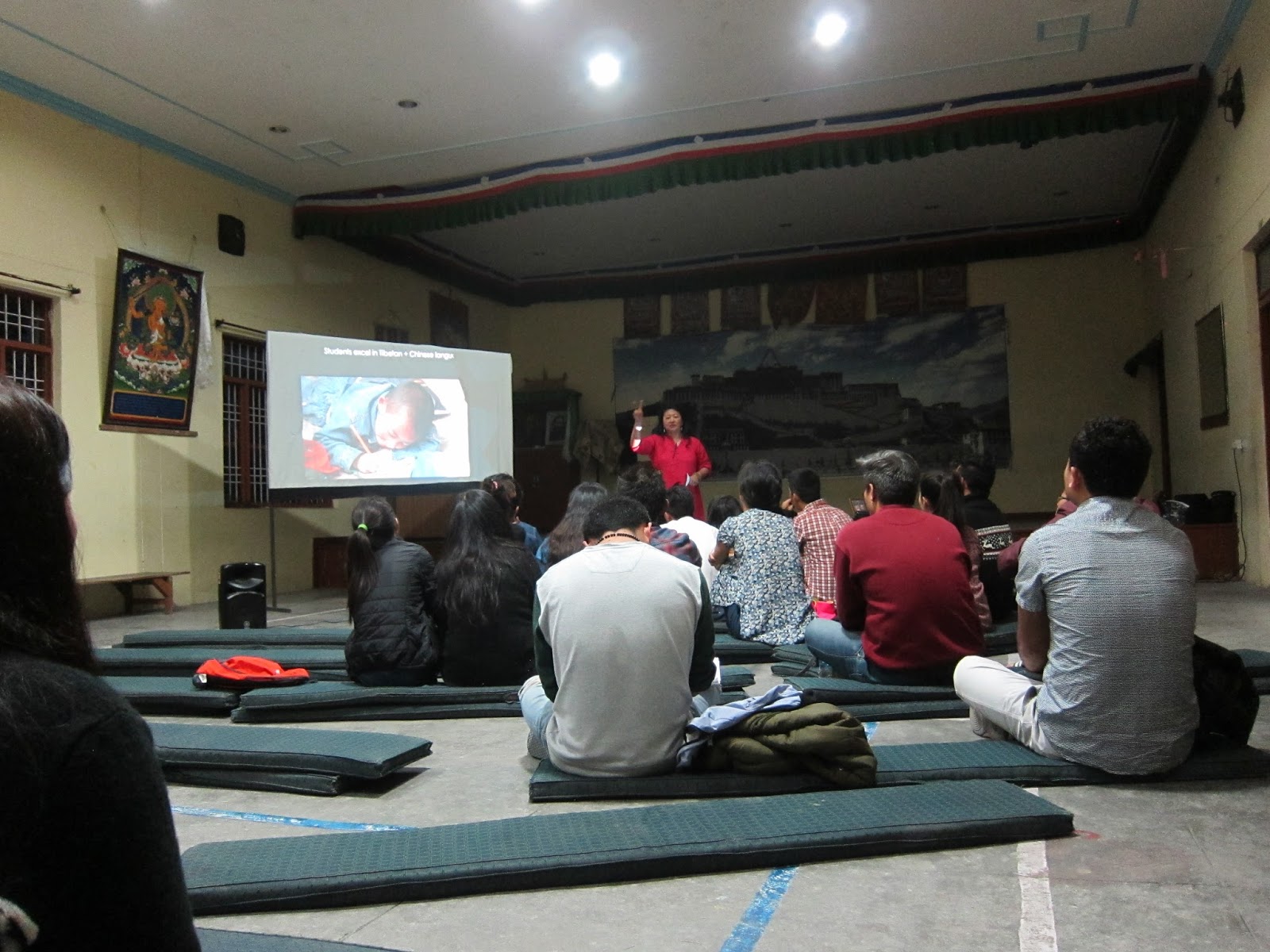
While walking through McLeod Ganj I came across a poster advertising a lecture about social entrepreneurship in Tibet, being held at the Tibetan Childrens Village Day School in McLeod Ganj that very night. I walked over to TCV and attended the lecture, passing some shops lit up by electric lights.

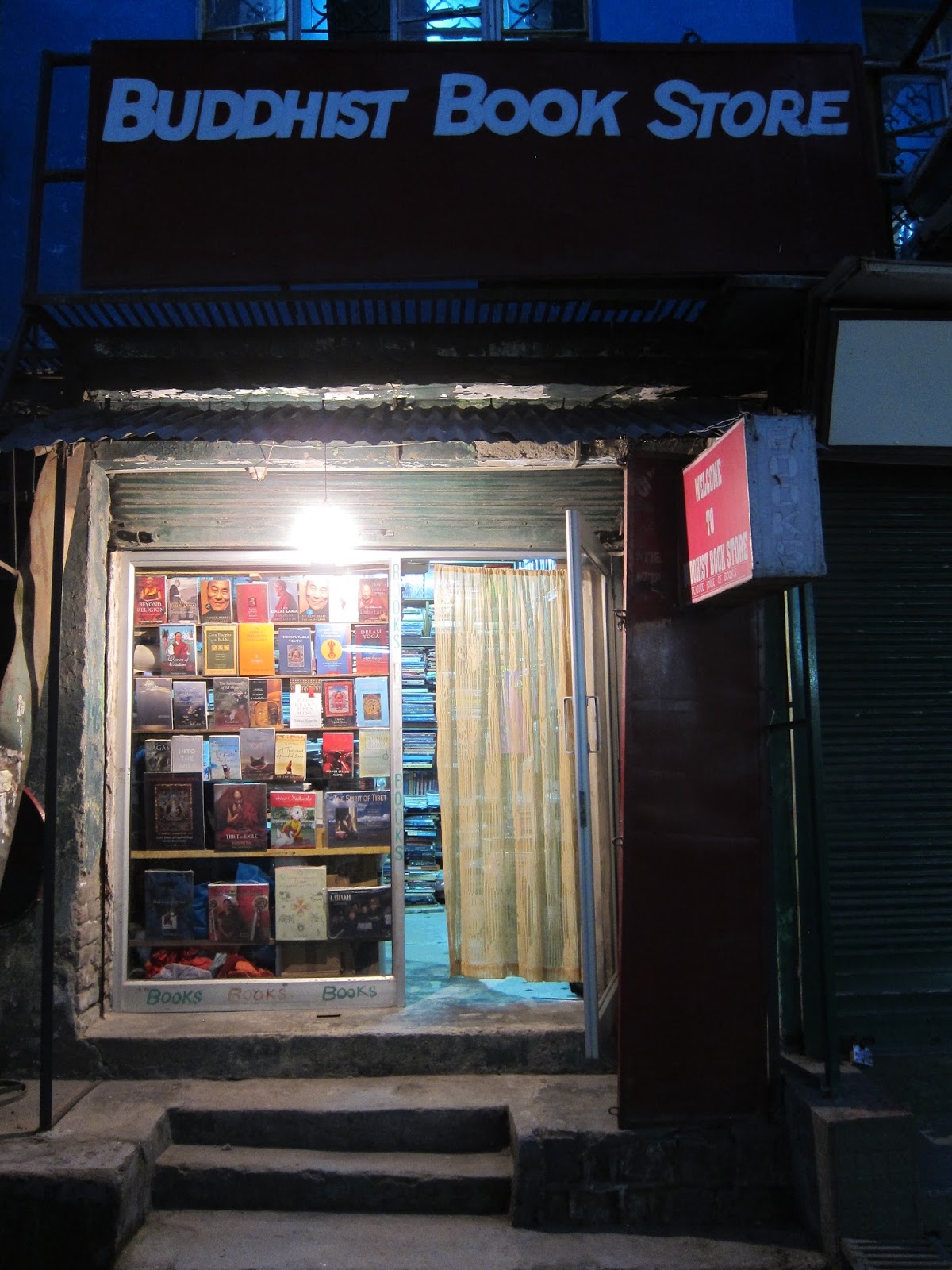
One of the bookshops in McLeod Ganj. 
I think I was the only non-Tibetan in the room for the lecture, which was given in Tibetan. I was enjoying myself - partly the lecture, and partly sitting on the floor at TCV Day with Tibetan youth interested in social entrepreneurship.

The speaker at one point asked me from the front of the room if I speak Tibetan. I shook my head no, and gave her a big smile. She apologized, and let me know the films she would play for us would be in English. It didn't matter - I was just happy to be there.

Lecture on social entrepreneurship in Tibet.
The event was organized by Machik. The Washington, DC based NGO was on a speaking tour of the Tibetan refugee settlements in India. I got to meet the presenter, Dr. Losang Rabgey at the conclusion of the event so I could thank her for her work.

I was very moved by this short video she showed during the presentation, as well as her beautiful spirit which I could understand even if I didn't understand the Tibetan.


Machik was founded by Dr. Losang Rabgey and her sister, Dr. Tashi Rabgey. Machik seems to hold events in the US and you can volunteer remotely, too - just sign up for their email list.

The next day, Tuesday, April 19, 2016 I went to Lobsang Choegyal Rinpoche's class from 2-4PM.

Lobsang Choegyal Rinpoche - April 19, 2016.
Geshe Lhakdor

I had only just heard through the grapevine that Geshe Lhakdor was teaching on The Precious Garland at the Library of Tibetan Works and Archives (LTWA), down the hill from McLeod Ganj.

I studied the Tibetan language at LTWA in 2015 and got to hear Geshe Lhakdor speak at our graduation ceremony, but had never gotten to hear him teach. I was really excited to get to attend his class on The Precious Garland at LTWA.

Geshe Lhakdor. Photo from Tibet.net.
Geshe Lhakdor has been serving His Holiness the Dalai Lama as a translator and religious assistant since 1989. He is also the Director of LTWA.

He taught on The Precious Garland by Acharya Nagarjuna for four days (Monday through Thursday) from 5:30PM - 6:30PM. I went to his class on Tuesday and Thursday. (I chose to skip the Wednesday class because I would have had to miss Geshe Kelsang Wangmo's class. Again, these are the choices one must make while in India.)

I took a walk down the hill from McLeod Ganj to LTWA's campus for the class, arriving at LTWA just in time for class.

Walk down the mountainside to LTWA campus.

It's a beautiful walk through the woods.
It is very sweet that people leave piles of food out for the street dogs.
I cam across this pile of rice and this black dog on my way to LTWA.
LTWA staff were so organized. I watched as they carefully prepared the room as well as the audio/visual equipment so that they could record and preserve Geshe Lhakdor's teachings. The first day's teaching is below. The rest are here.


His Holiness the Dalai Lama has also taught on The Precious Garland; you can watch the videos here.

After attending Lobsang Choegyal Rinpoche and Geshe Kelsang Wangmo's classes on Friday, I packed a weekend bag. (I kept a hotel room in McLeod Ganj from April 16 - May 11, even though I left for a few weekends. It was just easier.)

Then bright and early on Saturday morning I took the bus back to Deer Park Institute in Bir to attend more teachings given by Geshe Lhakdor.

Geshe Lhakdor teaching on Destructive Emotions.
Photo by Deer Park Institute.
He was leading a Retreat on Destructive Emotions based on Shantideva's A Guide to the Bodhisattva's Way of Life and Arya Deva's 400 Verses on the Middle Way. The retreat ran from Saturday, April 23 - Wednesday, April 27, 2016.

Retreat on Destructive Emotions. Flyer at Deer Park Institute.
Geshe Lhakdor teaching on Destructive Emotions.
Photo by Deer Park Institute.
I was happy, as always to be back at Deer Park Institute. On Saturday during our lunch break I noticed Geshe Lhakdor sitting on a bench, engaged in conversation with a guest. Beautiful.

Deer Park Institute.

Deer Park Insitute. Geshe Lhakdor on the bench with a guest.
It was a really fun retreat. Geshe Lhakdor explains things clearly and directly, with a sense of humor. He also spoke in Hindi sometimes, and then translated his exclamations into English. I enjoyed his energy and presence.

Geshe Lhakdor teaching on Destructive Emotions.
Photo by Deer Park Institute.
I had also gotten to receive teachings on the 400 Verses from Venerable Geshe Yeshe Thabkey la in Delhi in 2015. Lobsang Choegyal Rinpoche regularly teaches on A Guide to the Bodhisattava's Way of Life in his class in McLeod Ganj. So maybe slowly, through repetition, I will become a better student of these two texts.

The text Geshe Lhakdor had prepared for our use in class,
and my notes.
A Guide to the Bodhisattva's way of Life is a text by Acharya Shantideva. It is composed of ten chapters that discuss the development of the mind of bodhichitta through the practice of the six perfections.

The 10 chapters: (1) The benefits of bodhichitta (the wish to reach full enlightenment for the benefit of others) (2) Purifying bad deeds (3) Adopting the spirit of enlightenment (4) Using conscientiousness (5) Guarding awareness (6) The practice of patience (7) The practice of Joyous Effort (8) The practice of meditative concentration (9) The perfection of wisdom (10) Dedication

A Guide to the Bodhisattva's Way of Life explains all sentient beings are the cause for our enlightenment. Lama Zopa explained this:

Now, concentrate on the mosquito that is biting us and think, “The numberless buddhas are born from bodhisattvas, and the bodhisattvas are born from bodhicitta. The loving compassion thought, bodhicitta, is received from each sentient being. It is received from this mosquito who is biting me now.” So now, think, “My entire happiness is completely received from this mosquito.”
Geshe Dorji Damdul explained the meaning of Acharya Deva's text 400 Verses this way:

Four Hundred Verses on the Yogic Deeds, composed by Acharya Aryadeva is a seminal work on Buddhist philosophy and psychology, meant to help us traverse along the path towards greatest happiness and enlightenment. Dharma, the teachings of the Buddha have the connotation of awakening the true nature of our mind by cleansing the defilements. The purity of the true nature of the mind is referred to as the Clear Light, and it exists within each one of us. It is however often obscured by our adventitious stains and defilements.

These defilements of the mind are of two kinds – i. those which cause harm to others and ii. those which forbid one from embracing others with love. The defilements in the first category are mainly due to the four wrong views – view of misperceiving impermanent as permanent, misery as pleasure, impure as pure, and selfless as of selfhood. Elimination of the first category of defilements allows one to free oneself from miseries altogether, thus leading to nirvana. The first four chapters of Acharya Aryadeva’s ‘Four Hundred Verses on the Yogic Deeds’ are dedicated primarily towards this end. The fifth chapter of the text deals with overcoming the second category of defilements that forbid one from reaching out to others with love. The practice of altruism helps heal the individual from this defilement of self-centeredness, also referred to as the Bodhisattva’s ideals.

Geshe Lhakdor teaching on Destructive Emotions.
Photo by Deer Park Institute.
Students in the Retreat on Destructive Emotions.
Photo by Deer Park Institute.
On Saturday afternoon, after class had concluded for the day I walked through the fields behind Deer Park Institute to visit with my friend Anqui, who was renting a room in a house in the village. I cannot image a more peaceful, beautiful setting than her guest house.

The walk to Anqui's house.

The walk to Anqui's house.

Anqui's bedroom and balcony.

View from the balcony.
 We sat on her porch, enjoying the view, talking about social activism, and sipping tea. I sat on a rope swing chair. It was such a beautiful afternoon.
Her guest house.

Walking back to Deer Park Institute in the early evening.
I wrapped up the day with a meal of (Tibetan) vegetable momos at the Peace Cafe in Bir. Delicious.

My dinner.
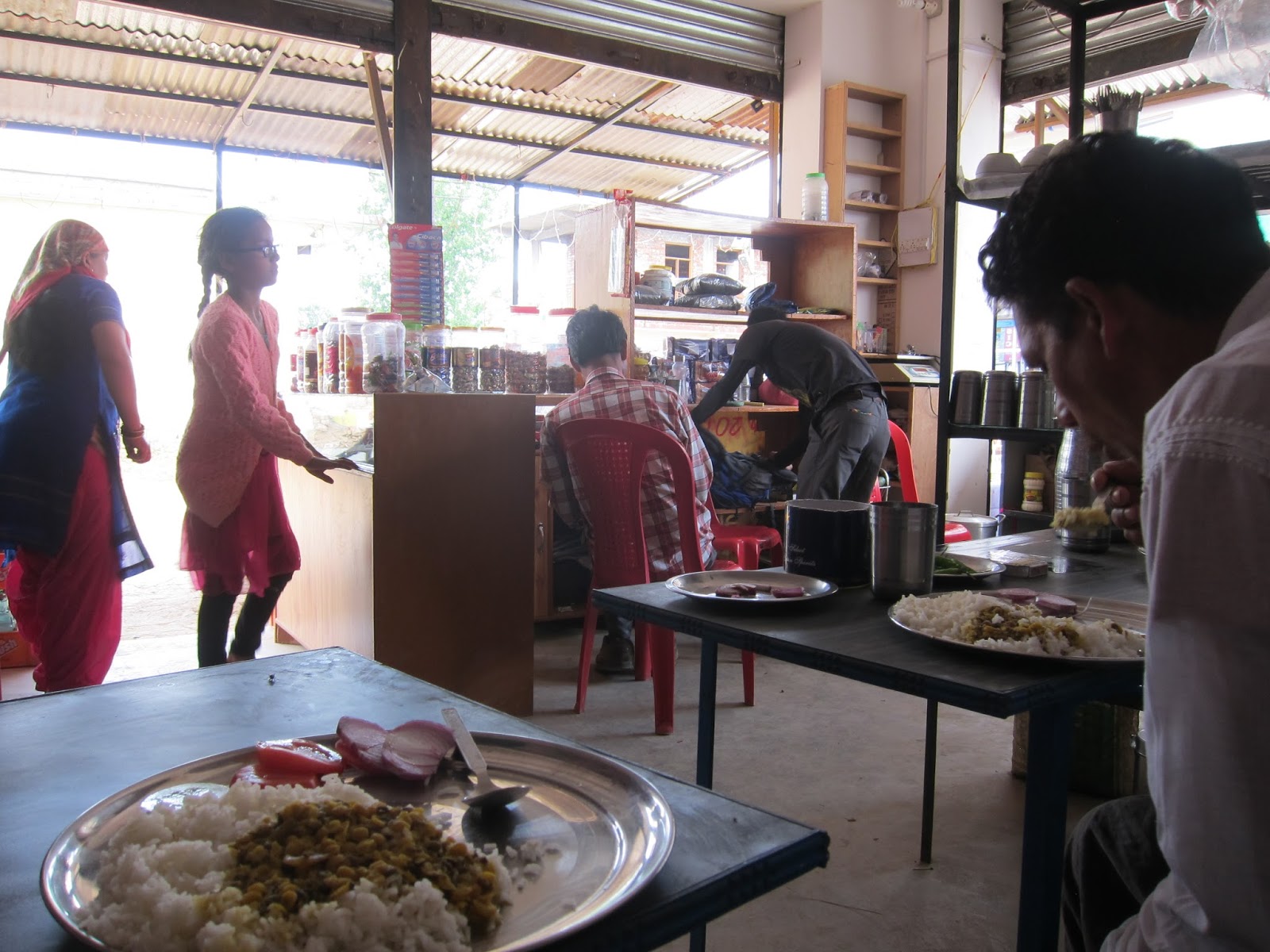
The following day, Sunday also turned out to be an unusually special day. I went to a roadside restaurant in Bir for a simple but delicious Indian lunch of rice and dal. Two members of the Deer Park Institute staff walked in and sat down, too. They kindly insisted on paying for me. I was so touched.

Family business - dal and rice lunch.

Roadside restaurant I ate at, across the street from the Surya Guest House
I had stayed in recently during Jetsunma Tenzin Palmo's Deer Park Institute retreat.
Rigo Tulku Rinpoche

After Geshe Lhakdor finished teaching for the day, My friend Maria and I went for a walk with one of her English language students. (Maria has taught English language classes to Bir residents offered through Deer Park Institute so Maria has many friends in Bir.)

We walked through the community outside of the Deer Park Institute campus, stopping to admire the view.

Going for a walk in Bir.

Going for a walk in Bir.

Going for a walk in Bir.

Going for a walk in Bir.

Going for a walk in Bir.
Maria's student is a monk studying at Palyul Choekhorling Monastery, one of the Bir monasteries. He stopped to show us his residence hall.
Residence hall.

Beautiful flowers.
 We then stopped at his monastery's administration office to ask about having prayers done for loved ones going through difficulties. This was hanging in the office above the desk:


We then went to visit the monastery's temple, and got to climb to the roof where there is a small room where monks do the same puja (prayers) each day. The view was lovely.

Looking out above the monastery's courtyard.

Looking towards the mountains.

The room on the roof, Maria's student.

Looking  down to the monastery's courtyard.

Afternoon beauty.

The room on the roof.
The balcony around the room on the roof, looking behind the monastery.
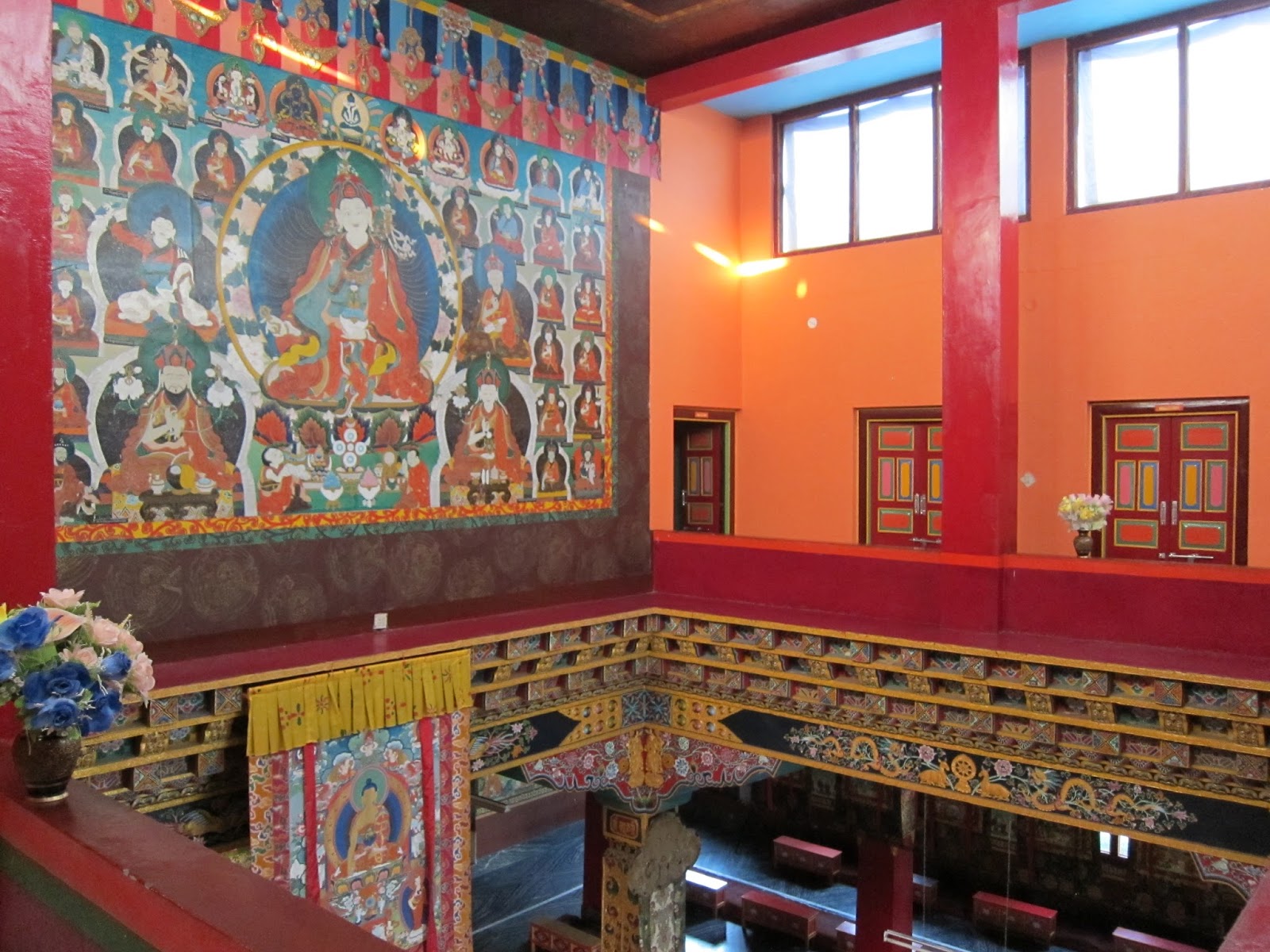
Maria, her student and I then entered the monastery's temple and went up to the second floor, where we had a beautiful view of the temple below by looking down the central opening.

Downstairs, outside of the Abbot's room. 

We waited to see if it was possible, and were then ushered into a room to see the abbot of the monastery, Abbot Rigo Tulku Rinpoche. Amazing. We got to speak with him for a few minutes and receive his blessings. He kindly agreed to have his photo taken with Maria and I.

Abbot Rigo Tulku Rinpoche, Maria, and I.
After this beautiful afternoon, I got back on the bus going to McLeod Ganj.

I was only able to stay in Bir for the first two days of Geshe Lhakdor's retreat (Saturday and Sunday) because I did not want to miss my regular classes in McLeod Ganj with Lobsang Choegyal Rinpoche and Geshe Kelsang Wangmo.

Earlier that day I got to approach and thank Geshe Lhakdor for his teachings. Unfortunately I missed the group photo with Geshe Lhakdor.

Geshe Lhakdor teaching on Destructive Emotions.
Photo by Deer Park Institute.
I am lucky there are opportunities to study on the weekends with amazing teachers like Geshe Lhakdor. In this way I have the opportunity to study seven days a week when I am staying in McLeod Ganj.

Trying to make the most of my time in India.